



South Shore Public Health Collaborative
Cohasset, Hingham, and Scituate MA working together to provide Public Health Resources & Health Education.
Advancing Public Health Together Since 2021
Cohasset, Hingham, and Scituate, MA have joined forces to create a collaborative approach to public health and health education. Through shared services, we provide essential programs such as inspectional services, hoarding support, crisis intervention, vaccine clinics, and preventative care. Our team is committed to staying at the forefront of public health, ensuring that South Shore residents receive the information, resources, and protection they need to thrive. As a Board of Health Collaborative, our mission is to promote the well-being of our communities through proactive, innovative, and compassionate public health initiatives.

WHAT IS PUBLIC HEALTH?
Public health is the science and practice of protecting and improving the health of communities through education, disease prevention, policy-making, and access to healthcare. Unlike clinical healthcare, which focuses on treating individuals, public health aims to enhance the well-being of entire populations by addressing health risks, environmental factors, and social determinants of health.



IN THE NEWS
South Shore Public Health Collaborative: ‘Protecting and Improving Community Health’ in Cohasset, Hingham, and Scituate
October 15, 2026 | By Carol Britton Meyer | Read the Article
PUBLIC ANNOUNCEMENT
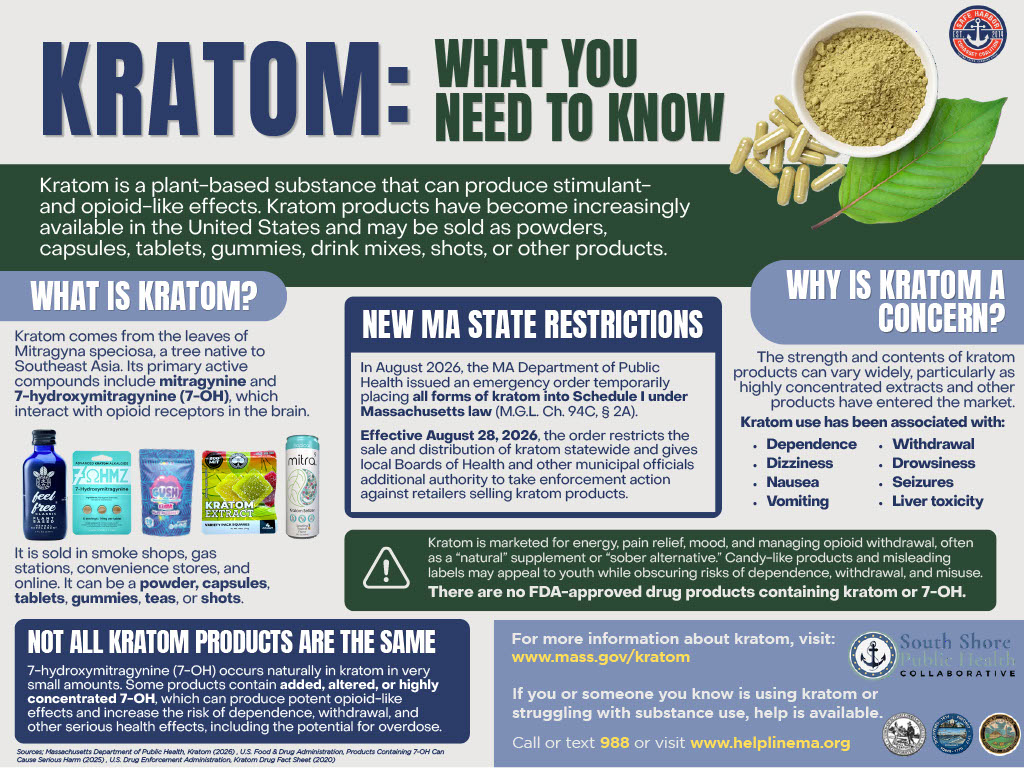
What is kratom and how does it work?
Kratom (Mitragyna speciosa) is a plant native to Southeast Asia. Depending on the amount used and its potency, kratom may produce different effects. Lower doses cause stimulant-like effects, such as increased alertness. Higher doses cause opioid-like effects, such as pain relief and sedation.
Kratom plants contain naturally occurring compounds that affect the brain, primarily mitragynine and trace amounts of 7-hydroxymitragynine (7-OH). These compounds can also be altered in a lab to create highly potent “synthetic” products that have more intense opioid-like effects. Specifically, synthetic products may contain high amounts of 7-OH, as well as mitragynine pseudoindoxyl (MP), dihydro-7-hydroxymitragynine (MGM-15), and 9-fluoro-7-hydroxymitragynine (MGM-16).
Kratom products may vary greatly. It may be difficult to know how a specific product will affect you, what compounds it contains, and how potent it is.
Recent state and federal actions will reduce the amount of kratom products, both synthetic and natural.
The South Shore Public Health Collaborative is funded through a state Public Health Excellence Grant, which provides local health departments with the funding for shared staff and resources, with a focus on adopting recommendations from the statewide Blueprint for Public Health Excellence.